Friday, August 18, 2006

SPOGGing Ourselves

This is the lead of a column we wrote for MSN Movies:
Becoming a part-time, high-school teacher isn't the easiest way to find good baby sitters, but it's better than, say, hanging out at the mall and hitting on everyone younger than 20 who's not riding a skateboard.
Note the unnecessary comma in red. An editor added this, but our name is on the top of the story, which makes us look like we shoot commas from a shotgun.

Tell us: Are we making a mountain out of this molehill? Or did the editor make a good call?

(Here's the whole story...)

Wednesday, August 16, 2006

Ask the Ayatollah

The Grand Ayatollah Sistani keeps a Web site where he posts the rules on everything from anal sex to wine drinking (with stops in the "clogne and perfume" department along the way).

SPOGG noticed that while both cockfighting and anal sex were "permissible but disliked/extremely abominable," grammar and spelling received nary a mention.

It must be an oversight, so we have written to the Ayatollah asking his opinion. Stay tuned...

Sunday, August 13, 2006

Give a Band a Bone

Today's junk-news wire delivers this small treat:

A band that headlined a fair last weekend is accused of masquerading as the rock group Redbone, whose hits included the 1970s song "Come and Get Your Love."

The band at the Butte-Silver Bow Fair performed under the name Redbone, but the real Redbone was playing in Wisconsin, said Ron Kurtz, Redbone's manager.

"I've been in the business for 40 years, and I've never ran into anything this blatant," Kurtz said Thursday from his office in Burbank, Calif. He said the fair board was conned.

It should be "I've never run into anything this blatant.


But really, are we surprised at the bad grammar of a band that pens lyrics like this?

Hell (Hell), what the matter with your head head
Hell (Hell), what the matter with your mind and your sign and a ohohoh
Hell (Hell) nothin the matter with your head baby find it, come on and find it
Hell, with it baby cause you're fun and you're mine and you look so divine.


Saturday, August 12, 2006

Acronyms: An Update

SPOGG's vice president for technology and precision, Barry L., writes with excellent clarifications on the acronym/abbreviation debate:

1. "An abbreviation is also made from the initial letters of other words, but it's not a separate word. C.I.A., for example. One may use periods with acronyms, or one may leave them out. It is a matter of style." Give that an edit, and change "acronyms" to "abbreviations" in the second sentence. (SPOGG: Yes! D'oh!)

2. "Acronyms are entirely new words made out of the initial letters of other words." That's correct, but most people would read it to be more restrictive than it is. That is, "initial letters" here *can* mean that you may take multiple letters from the same word, but most people would think it means only the first letter of each word. So you might want to clarify. "Radar", for instance, is an acronym taken from "RAdio Detection And Ranging", and military jargon is full of such acronyms ("CINCPAC" for "Commander IN Chief, PACific"; "SEAL" for "SEa, Air, Land", and so on).

And an aside: Some have used the term "backronym" to refer to an acronym that was defined BEFORE the phrase that it represents, and a phrase was then contrived to go behind it. Probably the most obviously ridiculous example of a backronym is in the name of the "USA PATRIOT Act", "Uniting and Strengthening America by Providing Appropriate Tools Required to Intercept and Obstruct Terrorism".


Thank you, Barry!

(See original post)

Friday, August 11, 2006

All the Jargon That's Fit to Bungle

Here's the lead of a nasty review in the New York Times.
SOME time ago, A. J. Jacobs, a senior editor at Esquire, set out to become the smartest man in the world, an ambition that meshed poorly with his skills set.
It's skillset. Not that we like that sort of jargon, but if one is going to be snarky about someone's book and writing skills, then one ought to get the spelling right.

Tuesday, August 08, 2006

Sherbet vs Sherbert

Dear SPOGG:

I was appalled to find that the word sherbet, according to my dictionary, may also be pronounced sherbert! What do you think?
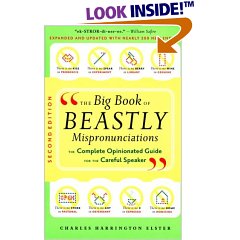
SPOGG thinks you would enjoy The Big Book of Beastly Mispronunciations. You might be surprised at the correct pronunciation of the spice cumin. We know we were surprised to read that "ask" was pronounced "ax" in the good old days. In any case, it's a very fun read.

A Dotty Question

Dear SPOGG:

Can acronyms have periods after each letter? I thought not, but others disagree...

Ah, it is time to point out the difference between acronyms and abbreviations. Acronyms are entirely new words made out of letters of other words. SCUBA, LASER and SPOGG are examples, though only SPOGG is new enough that it's still routinely capitalized. Some day... some day (insert shaking fist here).

One does not use periods with acronyms.

An abbreviation is also made from the initial letters of other words, but it's not a separate word. C.I.A., for example. One may use periods with abbreviations, or one may leave them out. It is a matter of style.

And speaking of style, this handsome SPOGG logo can be printed on a variety of products you want and badly need. Check out the SPOGG shop for more.

Embarrassing Celebrity E-mail

If only Lindsay Lohan had thought to hire an assistant to send out grammatically correct e-mails. Alas, this is what she foolishly dashed off to PerezHilton.com -- a gossip site that's frequently grammar-challenged:
"Almost witnessed 3 kids being hit by paparazzi," reads the email. "Never in my life had an expirience [sic] as I just did with the paparazzi. I am not kidding I am shaking, cannot breathe a bit, scared, anxious and sad. If someone doesn't feel bad, than [sic] I will feel bad for myself. It is disgusting what these g-d damn people are doing to me. As well as the people in my life that I work with/for. Its [sic] vulgar and I'm saddened for myself."
Here is the improved version:
"I almost witnessed three kids being hit by paparazzi," reads the e-mail. "Never in my life had an experience like I just did with the paparazzi. I am not kidding. I am scared, anxious, sad, and cannot breathe a bit [SPOGG tip: when listing things, move the longest item to the end for smoother reading.] If someone doesn't feel bad, then I will feel bad for myself. It is disgusting what these g-ddamn (one word) people are doing to me, as well as the people in my life whom I work with/for. It's vulgar and I'm saddened for myself."

(Vulgar isn't the right word here. Vulgar is more apt when describing someone wearing revealing clothes in an inappropriate place. Vulgar is a young girl's heavy smoking habit. Vulgar is talking about one's sex life in national magazines. Perhaps she means appalling. For some reason, it's the word that leaps to mind when Lindsay Lohan's name appears on screen.)

SPOGG thanks Sarah M. for the tip.

Sunday, August 06, 2006

What Kind of Lie?

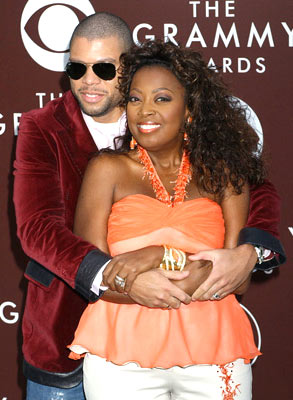
Star Jones doesn't like how people are talking about her marriage:
"These categorically false stories and their continuation are clearly being generated by someone for vindictive reasons alone. [Star Jones and Al Reynolds'] legal representatives have been investigating the source and motivation of these boldfaced lies for some time now and are very close to exposing the individual who has perpetrated them. At which time, appropriate legal action will be taken."
Forget the gossip about her husband. The real question is whether the lie is bald-faced, barefaced or boldfaced.

Here's what "Take Our Word For It" says:

The examples you cite are actually variations/corruptions of the original barefaced lie. Bare here means `brazen, bold.' However, in the 16th century, one source notes, barefaced meant `beardless,' a condition at that time considered bold to the point of audaciousness in adult men. So the metaphorical sense of `bold' perhaps came to be applied in barefaced lie. Based upon these two explanations, the variations bald-faced lie and bold-faced lie both make perfect sense.

We'll let you know if we find anything more definitive. What this really means is that Star and Al's PR agent is off SPOGG's hook... for now.

A Stylish SPOGG Salute

Dear SPOGG:

What are the standards still in use? I'm currently using "The Elements of Style" by Strunk and White, the Oxford English Dictionary (unabridged) and a couple different quick references online. Just wondering.
-- Eric

Dear Eric,

To give June Allyson's answer to happiness: Depends.

Grammar and style aren't quite the same thing. Let's define grammar as the parameters for putting together good sentences -- word order and all that. Style, meanwhile, refers to matters of punctuation and spelling.

Your question largely refers to style. Strunk & White remains a good choice. For spelling, OED is solid, though spelling can vary depending on who's publishing your writing. AP Style says "adviser," for example. Other stylebooks prefer "advisor."

Here's a list of several style guides.

Style can also depend on location. British punctuation rules differ from American ones.

SPOGG encourages you to pick the style that best fits your situation. Furthermore, SPOGG salutes you for being aware that different styles exist.