Monday, July 24, 2006

We Fear for David Hasselhoff's Heart

From Celebrity Week:

Hasselhoff To Star In Musical Based On His Life

First of all, we are NOT making this up. David Hasselhoff – star of Knight Rider, Baywatch and the new hit variety show America’s Got Talent told us today that he is heading to Australia to appear in a stage production based on his life.

David Hasselhoff: The Musical will include sets inspired by The Young and The Restless, Knight Rider and the songs of Teddy Pendergrass. “I am also doing a heart-rendering set on my life and the mistakes I have made,” the star says. “It sounds like a bad joke, but it is really going to be a good show…totally campy. It’s written by the same people who wrote Bette Midler’s show and produced by the people who produced Chicago in London.”
It's heartrending, Mr. Hasselhoff.

Though "render" does mean, among other things, "to purify fat, leaving small crisp remains." It's entirely possible your musical will do this to the audience, what's left of your dignity, or both. Delicious!

Sunday, July 23, 2006

Sunday Morning Mirth Insurance

SPOGG has spent the last week moving from one house to another, packing and unpacking boxes by the dozens, all during an unseasonal heat wave.

Perhaps it is needless to say that SPOGG is a bit cranky.

Our mood was lifted significantly, however, when we received a letter from our insurance company, informing us they have canceled our policy.

Ordinarily, a cancellation isn't such a happy thing. But when the letter contains such a sentence as this, we can't help but smile:

"Front steps are leaning, are crumbling."

Could the insurance adjusters be aspiring poets? Modern-day Wallace Stevenses? For their sake, we hope so. Otherwise, they just sound far too stupid to be insulting our steps.

Another thing that makes us feel better is Stevens' poem, Sunday Morning:

Sunday Morning

1
Complacencies of the peignoir, and late
Coffee and oranges in a sunny chair,
And the green freedom of a cockatoo
Upon a rug mingle to dissipate
The holy hush of ancient sacrifice.
She dreams a little, and she feels the dark
Encroachment of that old catastrophe,
As a calm darkens among water-lights.
The pungent oranges and bright, green wings
Seem things in some procession of the dead,
Winding across wide water, without sound.
The day is like wide water, without sound,
Stilled for the passion of her dreaming feet
Over the seas, to silent Palestine,
Dominion of the blood and sepulchre.

2
Why should she give her bounty to the dead?
What is divinity if it can come
Only in silent shadows and in dreams?
Shall she not find in the comforts of sun,
In pungent fruit and bright, green wings, or else
In any balm or beauty of the earth,
Things to be cherished like the thought of heaven?
Divinity must live within herself:
Passions of rain, or moods in falling snow;
Grievings in loneliness, or unsubdued
Elations when the forest blooms; gusty
Emotions on wet roads on autumn nights;
All pleasures and all pains, remembering
The bough of summer and the winter branch.
These are the measures destined for her soul.

3
Jove in the clouds had his inhuman birth.
No mother suckled him, no sweet land gave
Large-mannered motions to his mythy mind
He moved among us, as a muttering king,
Magnificent, would move among his hinds,
Until our blood, commingling, virginal,
With heaven, brought such requital to desire
The very hinds discerned it, in a star.
Shall our blood fail? Or shall it come to be
The blood of paradise? And shall the earth
Seem all of paradise that we shall know?
The sky will be much friendlier then than now,
A part of labor and a part of pain,
And next in glory to enduring love,
Not this dividing and indifferent blue.

4
She says, "I am content when wakened birds,
Before they fly, test the reality
Of misty fields, by their sweet questionings;
But when the birds are gone, and their warm fields
Return no more, where, then, is paradise?"
There is not any haunt of prophecy,
Nor any old chimera of the grave,
Neither the golden underground, nor isle
Melodious, where spirits gat them home,
Nor visionary south, nor cloudy palm
Remote as heaven's hill, that has endured
As April's green endures; or will endure
Like her rememberance of awakened birds,
Or her desire for June and evening, tipped
By the consummation of the swallow's wings.

5
She says, "But in contentment I still feel
The need of some imperishable bliss."
Death is the mother of beauty; hence from her,
Alone, shall come fulfillment to our dreams
And our desires. Although she strews the leaves
Of sure obliteration on our paths,
The path sick sorrow took, the many paths
Where triumph rang its brassy phrase, or love
Whispered a little out of tenderness,
She makes the willow shiver in the sun
For maidens who were wont to sit and gaze
Upon the grass, relinquished to their feet.
She causes boys to pile new plums and pears
On disregarded plate. The maidens taste
And stray impassioned in the littering leaves.

6
Is there no change of death in paradise?
Does ripe fruit never fall? Or do the boughs
Hang always heavy in that perfect sky,
Unchanging, yet so like our perishing earth,
With rivers like our own that seek for seas
They never find, the same receeding shores
That never touch with inarticulate pang?
Why set the pear upon those river-banks
Or spice the shores with odors of the plum?
Alas, that they should wear our colors there,
The silken weavings of our afternoons,
And pick the strings of our insipid lutes!
Death is the mother of beauty, mystical,
Within whose burning bosom we devise
Our earthly mothers waiting, sleeplessly.

7
Supple and turbulent, a ring of men
Shall chant in orgy on a summer morn
Their boisterous devotion to the sun,
Not as a god, but as a god might be,
Naked among them, like a savage source.
Their chant shall be a chant of paradise,
Out of their blood, returning to the sky;
And in their chant shall enter, voice by voice,
The windy lake wherein their lord delights,
The trees, like serafin, and echoing hills,
That choir among themselves long afterward.
They shall know well the heavenly fellowship
Of men that perish and of summer morn.
And whence they came and whither they shall go
The dew upon their feet shall manifest.

8
She hears, upon that water without sound,
A voice that cries, "The tomb in Palestine
Is not the porch of spirits lingering.
It is the grave of Jesus, where he lay."
We live in an old chaos of the sun,
Or old dependency of day and night,
Or island solitude, unsponsered, free,
Of that wide water, inescapable.
Deer walk upon our mountains, and the quail
Whistle about us their spontaneous cries;
Sweet berries ripen in the wilderness;
And, in the isolation of the sky,
At evening, casual flocks of pigeons make
Abiguous undulations as they sink,
Downward to darkness, on extended wings.

The semicolon: a love story...

If you never thought punctuation could lead to love, think again....

New York Times' Modern Love Column


Oh Really?

This appeared in the Sunday New York Times' online edition (see link):
After filming on Fire Island, the cast and crew of a new ABC reality series took the hint: residents didn’t want them there. Seeing a town portrayed as all bars and hookups makes residents real angry.
Really angry, people. Really.

Friday, July 14, 2006

We Thought This Was Unnecessary


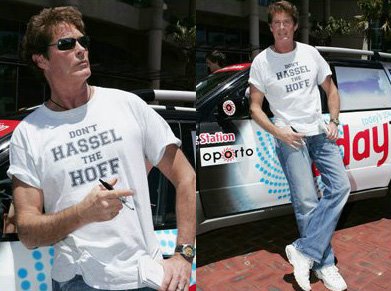
We saw this picture of shaving-accident victim David Hasselhoff and thought, "Tut, tut. His shirt makes a pun at the expense of good spelling."

We refrained from posting this amusing picture because we thought everyone knew how to spell hassle. Apparently, we were mistaken.

This came in today from a newsletter for children's writers we enjoy reading:
Let's play an old Sesame Street game called "Three of These Things" -- three of these articles ideas belong together, but one just doesn't belong here. Which one and why?

A Teaspoon of Kerosene for that Cough? Disgusting Doses from the Past.
I Vant to Suck Your Fluids -- Vampire Caterpillars.
Kids In the White House
Overcoming Homework Hassels -- Helping Kids Set Priorities
Oy to the vey! It's hassle. Also, the Sesame Street Song was went, "One of these things...."

Wednesday, July 12, 2006

Stink, Stank, Stunk

We got a sinking feeling today when we read this AP story:
By DAVID BAUDER, AP Television Writer Tue Jul 11, 6:00 PM ET

NEW YORK - TV viewers must have taken to the beach: It was the least-watched week in recorded history for the four biggest broadcast networks.

CBS, ABC, NBC and Fox averaged 20.8 million viewers during the average prime-time minute last week, according to Nielsen Media Research. That sunk below the previous record of 21.5 million, set during the last week of July in 2005.
It should be sank. That's the correct past-tense form.

Words like "sunk," "hung," and "shrunk" are past participles. We'll step right around that stinky pile of jargon, though, and say that a past participle is a verb that you use when you're talking about an action that's been completed. A clue is the presence of a helping verb, such as was, or has.
  • I've sunk your battleship.
  • I've shrunk the kids.
  • I've hung the photograph (but we say "hanged the criminal," perhaps because a felon "who was hung" means something entirely different, and entirely unappealing).

It Was a Dark and Stormy... Cliche

These might sound familiar:

The pen is mightier than the sword.
Pursuit of the almighty dollar.
The great unwashed masses.

They're all creations, now cliched, of the Victorian novelist Edward George Earl Bulwer-Lytton.
Oh, to spawn such immortal offspring.

The annual contest to parody the late, great author has just concluded. The winning entry is entertaining, of course. But SPOGG prefers the runner-up, especially when read in the Scottish accent of its author Stuart (STUART!) Vasepuru.
"I know what you're thinking, punk," hissed Wordy Harry to his new editor, "you're thinking, 'Did he use six superfluous adjectives or only five?' - and to tell the truth, I forgot myself in all this excitement; but being as this is English, the most powerful language in the world, whose subtle nuances will blow your head clean off, you've got to ask yourself one question: 'Do I feel loquacious?' - well do you, punk?"
Read more here.

Tuesday, July 11, 2006

Who vs. That

Recently, we found ourselves reading the grammar book "Woe Is I," by Patricia T. O'Conner, when something leapt off the page and slapped us upside the head.

It is correct, she wrote, to use either who or that when referring to people.

In making this outlandish pronouncement, she cited no higher authority — say, for example, the grammar and style deity E.B. White.

Absent such support, we don't understand what she was thinking.

That and which are for inanimate objects and unnamed animals. Who is for people and the occasional exceptional pet (see photo below).

Otherwise, once you let people be called "that," you also must let them be called "it". It's that simple.

This calls to mind the bestseller about abuse. Its title? "A Child Called It."

Are we really ready to let child-abusers set our language standards?

Or for that matter, televangelists? The disgraced TV minister Jim Bakker occasionally called his Praise the Lord group "People That Love," possibly even while requiring his secretary to perform acts prohibited by the Ten Commandments.

People, none of this is okay.

We're certain O'Conner meant well, but we firmly believe she gave bad advice here. It's off to the doghouse with her (not it).

Misty, who was the best dog in the world

Monday, July 10, 2006

Dashing Toward Brilliance?


So the pointed use of a dash is all we have to do to be called brilliant? SPOGG thinks that's brilliant!

From Slate:
Back at the Times, longtime court reporter Linda Greenhouse cites legal praise for [Chief Justice John] Roberts' real passion, which is not modesty but punctuation. As proof, Yale professor Akhil Amar points to one line from a recent Roberts opinion: "The state did—nothing." Amar tells Greenhouse, "That little dash is brilliant."
Not that we obsess about punctuation (okay, we do), but the dash here is an en-dash, not an em-dash. The en-dash is narrower — the width of a capital N. We'll let your brilliant deductive mind figure out how wide an em-dash is.

For the most part, en-dashes are pretty much exclusively used in books. Newspapers typically replace them with hyphens. When used properly, en-dashes show ranges in dates (October–December), page numbers, game scores and the like. If you want to get very persnickety, you will use it also to link compound modifiers (a Swift-Boat–style character assassination).

An em-dash shows a sudden break in thought, and is what Slate should have used.

We could not tell from source code what their writer intended, and perhaps Slate has some kooky style that bars em-dashes from their pages. Chief Justice Roberts did use one, at least according to the ruling we read here.

For that, we will give him full credit for prudence in punctuation, if not for jurisprudence.

Sunday, July 09, 2006

The Weekend Movie Edition


Two movies that excite us opened this weekend, A Scanner Darkly and Pirates of the Caribbean: Dead Man's Chest.

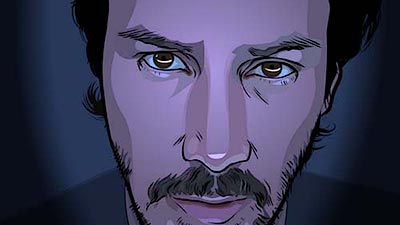
A Scanner Darkly is based on the Philip K. Dick tale about a narc who's having an identity crisis. Though SPOGG tends to pay particular attention to movies that are based on books, what has us excited is the animation technique, called rotoscoping. (Click here for a definition.)

This is one of those words that isn't yet in conventional dictionaries, but we predict will become familiar to the masses because it looks so darned cool. (Check out the trailers.)

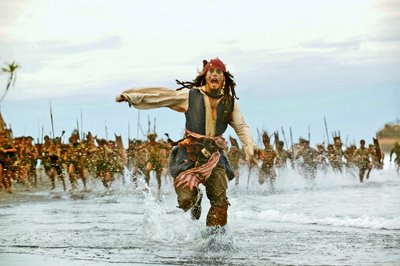
Pirates is of interest to SPOGG, not only because of Johnny Depp, whom we've loved since "21 Jump Street," but also because of the pronunciation of Caribbean. (See trailers.)

We heard our local NPR critic say, "cuh-RIB-be-an." And yet, we say "care-ub-BE-an," and have ever since we first visited Disneyland and its fantastic ride in 1976.

So which is correct?

The talking dictionary at Encarta says we are, though lists as a secondary pronunciation the one our NPR guy used. (Hear it.)

Our policy is to go with the first pronunciation listed, so we are doing a small superiority dance in the privacy of our own home, which is the only place our family allows us to dance.