Monday, July 10, 2006

Dashing Toward Brilliance?


So the pointed use of a dash is all we have to do to be called brilliant? SPOGG thinks that's brilliant!

From Slate:
Back at the Times, longtime court reporter Linda Greenhouse cites legal praise for [Chief Justice John] Roberts' real passion, which is not modesty but punctuation. As proof, Yale professor Akhil Amar points to one line from a recent Roberts opinion: "The state did—nothing." Amar tells Greenhouse, "That little dash is brilliant."
Not that we obsess about punctuation (okay, we do), but the dash here is an en-dash, not an em-dash. The en-dash is narrower — the width of a capital N. We'll let your brilliant deductive mind figure out how wide an em-dash is.

For the most part, en-dashes are pretty much exclusively used in books. Newspapers typically replace them with hyphens. When used properly, en-dashes show ranges in dates (October–December), page numbers, game scores and the like. If you want to get very persnickety, you will use it also to link compound modifiers (a Swift-Boat–style character assassination).

An em-dash shows a sudden break in thought, and is what Slate should have used.

We could not tell from source code what their writer intended, and perhaps Slate has some kooky style that bars em-dashes from their pages. Chief Justice Roberts did use one, at least according to the ruling we read here.

For that, we will give him full credit for prudence in punctuation, if not for jurisprudence.

Sunday, July 09, 2006

The Weekend Movie Edition


Two movies that excite us opened this weekend, A Scanner Darkly and Pirates of the Caribbean: Dead Man's Chest.

A Scanner Darkly is based on the Philip K. Dick tale about a narc who's having an identity crisis. Though SPOGG tends to pay particular attention to movies that are based on books, what has us excited is the animation technique, called rotoscoping. (Click here for a definition.)

This is one of those words that isn't yet in conventional dictionaries, but we predict will become familiar to the masses because it looks so darned cool. (Check out the trailers.)

Pirates is of interest to SPOGG, not only because of Johnny Depp, whom we've loved since "21 Jump Street," but also because of the pronunciation of Caribbean. (See trailers.)

We heard our local NPR critic say, "cuh-RIB-be-an." And yet, we say "care-ub-BE-an," and have ever since we first visited Disneyland and its fantastic ride in 1976.

So which is correct?

The talking dictionary at Encarta says we are, though lists as a secondary pronunciation the one our NPR guy used. (Hear it.)

Our policy is to go with the first pronunciation listed, so we are doing a small superiority dance in the privacy of our own home, which is the only place our family allows us to dance.

Saturday, July 08, 2006

This "Literally" Drives Us Crazy

We just discovered a blog that tracks abuse of the word "literally."

Literally, a Weblog

We, too, get the insane-clown hyena giggles when we hear people say "literally" when they mean "figuratively."

That said, it's done often enough that many language experts recognize a figurative meaning of literally has emerged. It's used to intensify the meaning of something.

We get that. We really do. But you won't catch us using literally when we mean figuratively. We'd literally rather stick a fork in a socket.

Friday, July 07, 2006

Caught in the Spam Filter

Subject line: Full of health? Then don't click!

This reminded us of two discussions SPOGG has had recently with people about the words "healthful" and "healthy."

The sane discussion was with a friend, who was taught that the word "healthful" must be used when discussing certain types of foods and behaviors.

The insane discussion was with a complete stranger who sent many increasingly angry and rude e-mails in response to our decision to use "healthy" as a synonym for "healthful" in an Encarta column. We suspect she had a bad case of post-traumatic sentence-diagramming syndrome.

It is true that healthful means "beneficial to health."

One would never be incorrect when describing a carrot as a "healthful" snack. One might be considered pompous. Possibly prissy. Definitely in possession of a stick (or carrot) where the sun don't* shine.

But one would be equally correct calling the carrot "healthy."

This is because healthy means the same thing, and has since at least the time Shakespeare, in Henry IV, wrote, "the water it selfe was a good healthy water."

Even today, both the OED and other dictionaries recognize healthy as a legitimate synonym for healthful.

It's perfectly fine to describe food as healthy. It'a also fine to call it healthful (particularly if you are the type to iron your socks and underwear).

You wouldn't describe a person as healthful, though, unless you were planning to eat him. And we don't think we need to remind you that this is both sick and wrong.

This is one of those times when people cling to a rule without fully understanding the reasons behind it. Healthful has a narrower definition than healthy, just as apple is more narrowly defined than fruit. The words are synonyms, but not interchangeable.

The grammar police will not arrest you for describing your apple as a healthy snack.

* Yes, we know it should be "where the sun doesn't shine." But this isn't how the idiom goes, and we respect idioms as much we respect traditional grammar rules.

Thursday, July 06, 2006

The Dictionary: A Mirror of our Soul

It's been 100 years since "Americanize" first appeared in Merriam-Webster' s Dictionary. Same goes for presidential, constitutionality and amendatory — words that remain all the rage today, along with fellow centarians immigrant, inexact and porcine.

Will this year's new words also last a century?

Let's hope spyware doesn't. Ringtones annoy us, as do drama queens. If these things no longer existed, we wouldn't need them to appear in our dictionaries.

Likewise, we wouldn't need gastric bypass without supersize.

Polyamory
and sandwich generation are not synonyms, no matter what the image suggests, so we're glad to see those between the sheets (of paper in the dictionary, that is).

And unibrow? That one's been a long time coming, eh, Bert?

Check here for more new words.

Wednesday, July 05, 2006

They Asked for It

We never signed our blog up to receive promotional spam, but we get daily doses anyway from 20th Century Fox.

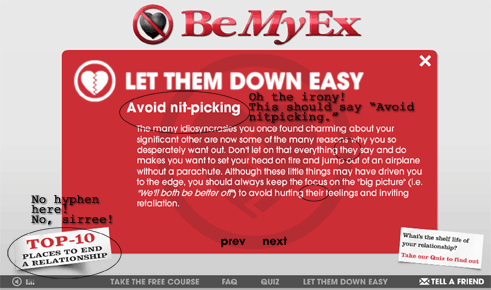
Some of the marketing is clever. Some, while still clever, leaves a bit to be desired when it comes to grammar. We've circled a few errors from BeMyEx.com, which was built to promote My Super Ex-Girlfriend.

Click the image if you'd like to enlarge it.

Meanwhile, 20th Century Fox, SPOGG would be happy to correct the grammar of your promotional material before it goes live. We could learn to live on Hollywood wages. Loveyoumean it! Kiss, kiss! Call us!

Should We Simplify Our Spelling?

The American Literacy Council objects -- and has for a century -- to the way we spell words. English isn't phonetic, and although the kooky spellings sometimes help illuminate the meaning of words (particularly those from Latin), they make it tough for children and immigrants.

SPOGG could not agree more.

While we're sympathetic with those who love the history of language, and while we ourselves are former spelling champions who love to figure out what words might mean based on their parts, we believe language must be about more than tending time capsules.

Language exists so that we can understand each other, and communicate ideas clearly.

When spelling gets in the way of this, it's time to change the way we do things. This is easier said than done, of course. It would be incredibly expensive, and it would be hard on people who've already learned the old-fashioned way. But spelling standardization has happened in the past (most likely in the 1600s, bolstered by the existence of the printing press).

We could leverage the Internet and word-processing software in much the same way, spreading logical English around the globe.

Language should not be a fortress inhabited by the elite, and that's what we've created with our idiosyncratic spelling system.

Visit the American Literacy Council

Monday, July 03, 2006

The SPOGG Link Exchange

SPOGG wants to create a network of like-minded blogs and Web sites.

If you'd like us to link to you, and you're able to link back to us, please shoot us an e-mail.
Let's Bee Friends!

Sunday, July 02, 2006

I'm Gonna Git You, Smucker's!

Okay, that headline was a pathetic reference to what is probably an even worse movie.

But can you blame us? This jam label, sent by SPOGG lieutenant Judy M., really crushes our berries:


It's true that there is less sugar and fewer calories in this reduced-sugar concoction (a hyphen there beneath the Concord Grape would have been nice, Smucker's).

But it should be "1/2 the calories and sugar of regular jelly!" Or, "half as much sugar as regular jelly."

Plural Trouble

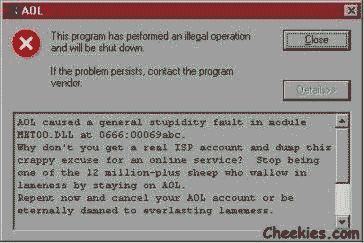
This just in: AOL makes it tough for subscribers to cancel.

In the midst of that breaking news, though, the NY Times demonstrates clumsiness of its own with plural possessives:

In 2004, AOL signed an agreement with the Federal Trade Commission about problems related to — care to make a guess? — subscriber's requests for cancellation. That was followed last year with an "assurance of discontinuance" reached with Eliot Spitzer, the New York attorney general, concerning — yes — subscriber's requests for cancellation. In both cases, investigations had revealed that AOL practiced a strange form of customer service, continuing to bill subscribers who had called to cancel, and had thought that they had done so, but who were marked down as "saved."
We know the AOL trouble affects more than one subscriber. So, it should be subscribers', with the apostrophe coming after the "s."

Here's the trick:

1) Form the plural
2) Add the apostrophe or apostrophe+s, depending on the style you're following.

A note on style: Though there is disagreement on this, the rule we like says put the "s" after the apostrophe if you pronounce it. The Joneses'* cat, as opposed to the Smiths' cat.

Because there is enough passionate disagreement that you can't possibly please all the sticklers out there, the best thing to do is be consistent with whatever method you choose.

* corrected, thanks to Barry L.